

Categories
Buying/Selling, MovingPublished October 30, 2026
Property Taxes Explained: A Direct Comparison Between Southern California and Iron County Assessments.

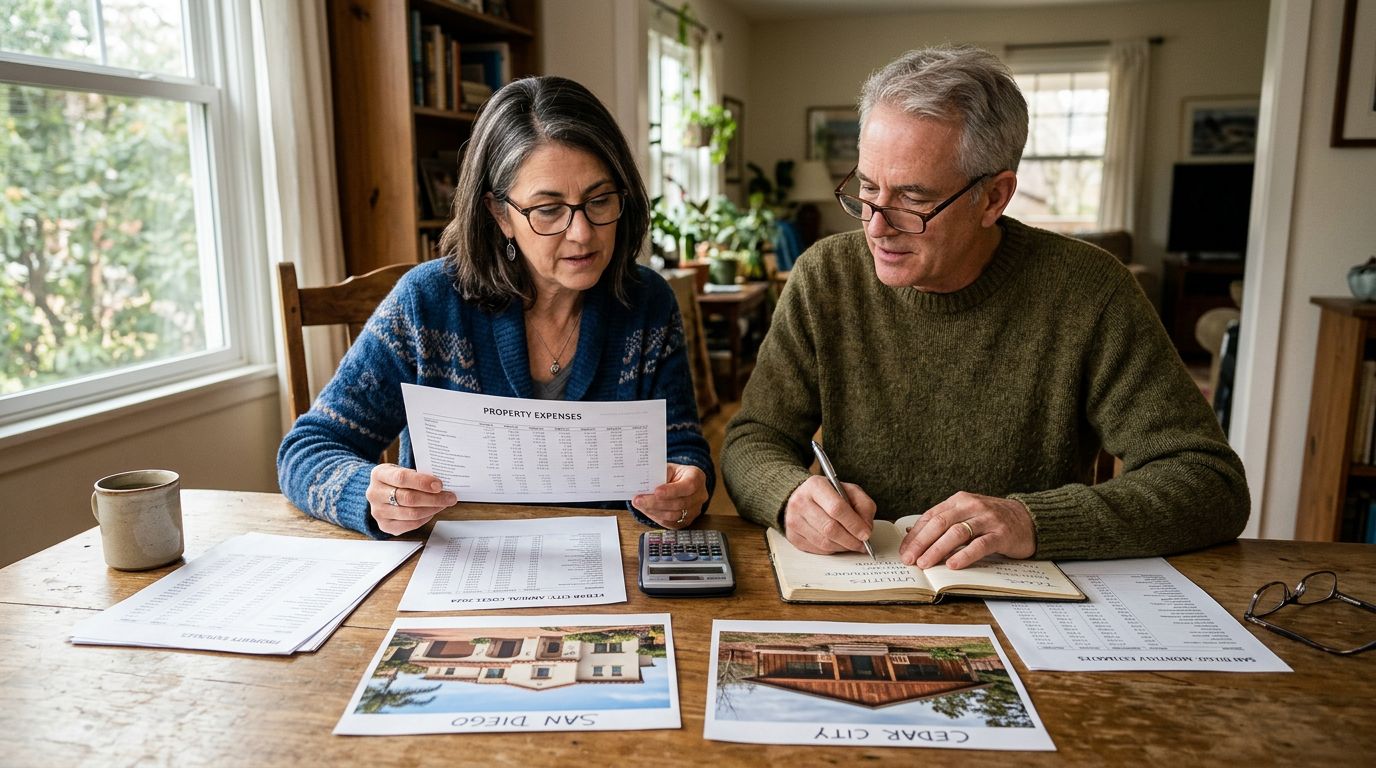
Your San Diego property tax bill may be based on a home value established decades ago. Moving to Cedar City means entering a different assessment system, with different exemptions, tax rates, and responsibilities.
If you've owned your San Diego home for fifteen or twenty years, there's a good chance its current market value is considerably higher than the value used to calculate your property taxes. California's Proposition 13 has allowed many longtime homeowners to retain assessments tied to their original purchase prices, with limited annual increases.
That changes when you purchase a home in Cedar City.
Utah evaluates residential property using current fair market value and offers a substantial exemption for qualifying primary residences. The resulting tax bill may be lower than what you're accustomed to paying in California, although the difference depends on your existing assessment and the property you purchase.
Understanding Iron County property taxes before relocating will give you a more realistic picture of your future housing expenses.
For a proper comparison, you'll need to look at assessed values, available exemptions, and the tax rates associated with each property.

Table of Contents
- How California's Proposition 13 Determines Your Property Tax Assessment
- How Iron County Calculates Residential Property Taxes
- California vs Utah Property Taxes: A Side-by-Side Calculation
- Why California's Proposition 19 Won't Follow You to Utah
- Utah's 45% Primary Residential Exemption and the 2027 Filing Changes
- Why Your Seller's Property Tax Bill May Not Reflect Your Costs
- Comparing Annual Taxes Across Cedar City, Enoch, and Rural Iron County
- Property Tax Appeals, Valuation Notices, and Ownership Changes
- How Property Taxes Affect Your Southern Utah Purchase Budget
- How The Sam Dodd Team Helps Buyers Compare Ownership Costs
- Five Questions to Ask Before Relying on a Property Tax Estimate
- Frequently Asked Questions
- Understand the Full Cost Before Buying in Cedar City
How California's Proposition 13 Determines Your Property Tax Assessment
Your Purchase Date Matters
California's Proposition 13 establishes an assessment system based largely on a property's value when it changes ownership.
After a qualifying purchase, the property's assessed base-year value generally increases by no more than 2% annually, subject to inflation and applicable exceptions.
That limitation can produce a substantial difference between taxable assessed value and current market value.
If you purchased your home years ago, your assessment may remain tied to a much older valuation, even as nearby properties sell for considerably more.
Why Longtime Owners May Have Lower Taxable Values
Two neighboring homes in Carlsbad or Rancho Bernardo can have substantially different property tax bills despite having similar market values.
A homeowner who purchased in 2003 may have a much lower taxable assessment than someone who purchased a comparable property in 2025.
The California State Board of Equalization explains the assessment framework and circumstances that can trigger reassessment.
Temporary declines in market value can also affect assessments under Proposition 8, with different adjustment rules as values recover.
Why Your Bill Can Exceed 1%
Proposition 13 generally limits the basic property tax levy to 1% of taxable assessed value.
However, voter-approved indebtedness, special assessments, and certain additional charges can increase the amount due.
California also issues supplemental assessments following qualifying ownership changes or completed new construction. These adjustments account for changes in assessed value during the relevant tax period.
Your actual tax bill therefore involves more than multiplying today's market value by 1%.
Important California Assessment Distinction
A California property's current market value and taxable assessed value can be substantially different. When comparing your existing property taxes with a potential Utah purchase, use your actual assessment rather than assuming your California bill is based on today's sale price.
How Iron County Calculates Residential Property Taxes
Fair Market Value Comes First
The Utah property tax assessment process begins with a county assessor's determination of fair market value.
The Utah State Tax Commission explains that assessors generally value residential property at 100% of its fair market value, while seeking uniformity among comparable properties.
Unlike California's Proposition 13 framework, Utah doesn't generally preserve a homeowner's original purchase-based assessment indefinitely.
The assessed market value may change as market conditions and property characteristics change.
The Primary Residential Exemption
Qualifying primary residences receive a 45% exemption from market value.
This means the taxable value is generally 55% of the property's qualifying fair market value.
For a home assessed at $400,000, a full residential exemption would reduce the taxable value to $220,000.
The Utah primary residential exemption is one of the most important considerations when estimating taxes on a Cedar City home.
Your Tax Area Determines the Rate
Iron County's property tax rates vary depending on the taxing entities serving the parcel.
County, municipal, school district, and other authorized levies may contribute to the combined rate.
A property in Cedar City can have a different rate from one in Enoch, Parowan, or Brian Head.
The appropriate calculation uses the property's actual taxable value and applicable tax-area rate, rather than a single assumed countywide percentage.
California vs Utah Property Taxes: A Side-by-Side Calculation
The easiest way to understand the difference is to compare how two hypothetical properties are assessed.
These figures are illustrative arithmetic only. They are not current property listings or verified tax rates for specific addresses.
Hypothetical San Diego Property
Assume a California home has a current market value of $950,000.
Because the owner purchased years ago, its Proposition 13 assessed value is $475,000.
At the basic 1% levy, the calculated amount would be $4,750 annually, before additional applicable charges.
Hypothetical Iron County Property
Now consider a Cedar City home with a fair market assessment of $450,000.
Assuming the full 45% residential exemption applies, its taxable value would be $247,500.
Using an illustrative tax rate of 0.75%, the calculated annual property tax would be $1,856.25.
The 0.75% Utah rate is a hypothetical assumption, not a verified current Iron County tax-area rate.
Comparing the Calculations
| Measurement | California Example | Iron County Example |
|---|---|---|
| Current market value | $950,000 | $450,000 |
| Assessed market/base-year value | $475,000 | $450,000 |
| Residential exemption | Not included | $202,500 |
| Taxable value | $475,000 | $247,500 |
| Illustrative rate | 1% basic levy | 0.75% assumed |
| Calculated annual amount | $4,750 | $1,856.25 |
This example demonstrates how assessment rules and exemptions influence the calculation.
The actual result could be quite different.
When comparing California vs Utah property taxes, use the assessment information for your current home and a parcel-specific estimate for the replacement property.
How to Use This Comparison
The table demonstrates the calculation methods, not a guaranteed difference in actual taxes. Replace the hypothetical figures with your California assessed value, the Utah property's assessment and exemption status, and its current adopted tax-area rate before making a purchase decision.
Why California's Proposition 19 Won't Follow You to Utah
Proposition 19 is particularly relevant to California homeowners considering retirement or downsizing.
Under qualifying circumstances, certain homeowners, including those age 55 or older, may transfer an existing California base-year assessed value to another qualifying principal residence within California.
That provision can help eligible homeowners retain a favorable property tax assessment when moving to another California community.
However, the transfer is limited to qualifying replacement homes located in California.
You cannot transfer your California Proposition 13 assessment to a residence in Cedar City.
The California State Board of Equalization's Proposition 19 guidance explains eligibility and transfer requirements.
This deserves consideration if you're comparing relocation within California against leaving the state.
Also remember that property tax assessment transfers are separate from federal capital gains exclusions on home sales.
Utah's 45% Primary Residential Exemption and the 2027 Filing Changes
What Qualifies as a Primary Residence?
Utah generally defines a qualifying primary residence as a dwelling occupied as a primary domicile for at least 183 consecutive days during a calendar year.
The occupant may be the homeowner or an eligible full-time tenant.
The exemption is generally limited to one qualifying primary residence per household within Utah.
Primary Residences and Vacation Homes
This distinction can be particularly relevant in Southern Utah.
A residence in Cedar City occupied as your principal home may qualify for the exemption.
A vacation property at Brian Head that doesn't meet the relevant occupancy requirements generally won't receive the same treatment.
Without the exemption, the taxable value of a nonqualifying second residence may equal 100% of its fair market value.
For additional detail, see our existing guide to Iron County property tax exemptions.
What Happens With Larger Properties?
The residential exemption generally applies to the qualifying dwelling, associated improvements, and up to one acre of land per residence.
If you're purchasing several acres, the remainder may require separate consideration based on its classification and applicable rules.
Ask the assessor how the particular parcel is treated before relying on the exemption for the entire property.
Application Changes Beginning in 2027
The Utah primary residential exemption is also subject to new application requirements beginning January 1, 2027.
Under the changes described by the State Tax Commission, owners must file Form TC-473A in certain circumstances, including changes in ownership, previous ineligibility, and specified county reviews.
The published deadline is September 15. Late applications generally cannot be accepted by the County Board of Equalization.
If you're planning to purchase after these changes take effect, review the current filing instructions and confirm the necessary documents during your transaction.
Why Your Seller's Property Tax Bill May Not Reflect Your Costs
One mistake relocating buyers can make is treating the seller's previous tax payment as a reliable prediction of their own.
The prior owner may have qualified for a residential exemption that won't apply to your intended use. Improvements, changes in assessed value, or updated classifications can also influence future amounts.
The Utah property tax assessment system evaluates property under state valuation requirements, with the county responsible for determining its market and taxable values.
Before purchasing, review the parcel's current assessment, applicable exemption, and tax area.
Ask the appropriate county office whether your intended use could change the property's taxable classification.
The seller's bill provides useful history, but a purchase budget should account for the assessment conditions likely to apply during your ownership.
Comparing Annual Taxes Across Cedar City, Enoch, and Rural Iron County
Iron County property taxes vary across the county because different areas are served by different combinations of taxing entities.
Municipal boundaries, school district levies, and special districts can affect the combined rate.
A home with a Cedar City mailing address may also be situated outside municipal boundaries, making the property's actual tax area particularly important.
The Utah State Tax Commission publishes tax rates by area, allowing property owners to investigate applicable local levies.
For a purchase decision, use the most recent adopted rate associated with the actual parcel.
Avoid assuming that every home in Iron County shares a single rate or that the tax rates of neighboring communities are interchangeable.
Three Details to Confirm for Every Property
- Assessed value: The property's current county-assessed market value.
- Exemption status: Whether the intended residential use qualifies for the applicable exemption.
- Tax area: The specific combination of taxing entities and rates associated with the parcel.
Property Tax Appeals, Valuation Notices, and Ownership Changes
If you believe your property's market assessment is incorrect, Iron County provides a formal valuation appeal process.
According to the Iron County Board of Equalization, real-property valuation appeals generally must be filed by September 15 or within the applicable 45-day period following mailing of the valuation notice, whichever is later.
The Board considers disputes over property valuation, rather than general objections to tax rates or the total tax bill.
Supporting evidence should address the property's market value for the relevant assessment period.
If your question concerns exemption eligibility or another classification issue, contact the appropriate county office about the correct procedure.
California has its own assessment appeal rules, including procedures for disputed values and qualifying temporary declines in market value.
An appeal does not guarantee a reduction.
How Property Taxes Affect Your Southern Utah Purchase Budget
When comparing Cedar City property taxes, the annual obligation should be part of your complete ownership budget.
A homeowner financing a purchase may have property taxes included in a monthly mortgage escrow payment, depending on the loan arrangement.
Cash buyers remain responsible for paying their property taxes directly.
You should also consider insurance, utilities, HOA dues where applicable, and expected maintenance costs.
If you're comparing several properties, create a simple annual expense estimate for each one using available tax information and the intended occupancy.
A home with a lower purchase price may still have different ongoing expenses than another property, especially when exemptions, acreage, or maintenance obligations vary.
For broader market context, our Cedar City affordability comparison explores other housing-cost considerations.
How The Sam Dodd Team Helps Buyers Compare Ownership Costs
At The Sam Dodd Team, we help buyers explore available properties throughout Cedar City and the surrounding Southern Utah communities.
For California homeowners relocating to Iron County, understanding property tax classifications and likely ownership expenses is an important part of comparing homes.
We can help you identify relevant property information, arrange showings, and navigate the Utah buying process.
The county assessor and qualified tax professionals remain the appropriate resources for property-specific assessments, exemption determinations, and individualized tax advice.
Explore our home-buying resources or search available Southern Utah properties to begin comparing options.
Five Questions to Ask Before Relying on a Property Tax Estimate
Before making an offer, establish the following:
- What is the current assessed market value? Verify the county's recorded assessment for the parcel.
- Which tax area applies? Confirm the combined rates for the property's actual location.
- Does the home qualify for the residential exemption? Review the existing classification and eligibility requirements.
- Will your occupancy change the calculation? Distinguish primary residence use from vacation or second-home ownership.
- Are there filing or appeal deadlines? Check application requirements and current valuation notices.
These details provide a stronger basis for budgeting than a general countywide tax estimate.
Frequently Asked Questions
Understand the Full Cost Before Buying in Cedar City
If you're moving from Southern California, understanding Iron County property taxes will help you compare homes with a clearer picture of long-term ownership expenses.
The Sam Dodd Team can help you explore Cedar City properties and evaluate the considerations that matter to your purchase.
Contact The Sam Dodd Team to discuss your Southern Utah home search.

Sam Dodd
Operator/Agent | Sam Dodd Team | eXp Realty | PLACE
or another way